
Published Issue 148, April 2026
As the scavenger creeps through the hallway, I sneak up behind him, wrap my arms around his neck, and squeeze. With a pull and a lift, his feet come off the ground, and we topple backward, landing on the floor with him crashing on top of me. He squirms, his hands reaching and swatting at my face, but I don’t let up. I tighten my grip and hold the pressure, crushing his throat, strangling the life out of him. He tries to gasp for air, but he can’t. It lasts a minute, maybe more, and then the scavenger is no more. Breath will never reach his lungs again.
I shove his limp carcass off me and remain lying down until I’ve caught my breath. And then I sit up, fast, peering around this dank and dusty house.
“Christine?” I call out. “Christine, where are you?”
—
Every morning, when the sun rises to greet the ashen wastelands, I scour the earth in search of my wife. I always find her, but come dawn, she’s gone again.
Our day-to-day consists of traveling on foot, from one desolate location to the next. At night, we set up camp on the barren ground, eat what food we can scrounge, and fall asleep nestled together in our sleeping bag.
In the morning, she’s wandered off, and I must repeat my search.
Despite the landscape festering with smoke and blood, and ash descending from the sky like black snowflakes, whenever I locate Christine, she remains as immaculate as she was on our wedding day. In a world of filth and constant nomadic traveling that leaves me sweaty and dirty, Christine’s clothes remain white and untarnished, her skin as pure as cold stream water. I suspect she’s been sneaking off in the mornings to wash and clean herself, but who am I kidding? The creaks dried long ago. The chances of her wearing an invisible cloak, a protective shield to keep her from the muck and grime of our new life, is a greater probability.
It’s the days and the miles that have taken their toll on me; you can see it in my sunken, dry eyes, the scruff of hair on my hollow cheeks, and the dirt caked to my emaciated frame. Since the downfall of our world, I’ve aged exponentially.
Christine looks as young as ever.
—
Morning arrives. I wake up alone. The search begins. This time, I find my wife in a clearing surrounded by rotten pines, miles from the old stable where we took shelter the night before. When I catch up to her, I snatch her in my arms and embrace her with as much aggravation as relief.
“Where are you going?” I ask her. I already know the answer. Because I’ve asked this question what feels like a thousand times.
Home. She wants to go home.
“I want to go home,” Christine utters, her unsoiled face inexpressive, catatonic.
“There is no home to return to,” I say. “You know that.”
With my backpack securely tightened on my back and the rifle sling adjusted on my shoulder, I cautiously gauge our surroundings for any nearby threats. There could be others in these woods — scavengers, looters, killers — but I don’t see or hear anything in our proximity.
“You can’t keep running off like this,” I whisper to my wife — for the thousandth time. “Now come — we have to keep moving this way.”
I take Christine’s hand and lead her through the silent woods in the opposite direction.
—
Another night, another camp set. A pot of soup boils over the small fire I made. I scarf my meal, ravenous with hunger from the day’s endless trekking and the additional miles I had to backtrack to find my wife.
Christine’s bowl lies on her lap, untouched.
“You should eat,” I tell her.
“We should go home,” she says.
I have no response. What can I say that I haven’t said before?
The heat rises with the sun, and I wake up to find my sleeping bag zipper undone and Christine missing from her usual spot beside me. I’ve come to expect this. What once made me jump with panic now only makes me sigh with frustration.
I pack our belongings, kick dirt over the smoldering fire, and set out for my wife. Like all the previous mornings, I find her moving in the direction from which we came the day before.
—
As she wades through the thick brush, I hustle over to her, grabbing at her shoulder and forcefully spinning her around to face me. “Where are you going?” I hiss at her.
She won’t look at me. “Home,” she says.
“I told you, there is no—”
A branch snaps in the distance. Leaves rustle. My ears perk up to listen.
A deep, apprehensive voice, booming, threatening, echoes beyond the dense growth of foliage. “I see something! Over there!”
I clutch my wife’s hand. “This way,” I whisper sharply, and we flee.
I run and run, pulling my wife along as we sprint through the thick forest. Christine struggles to keep up (it’s like dragging a stubborn mule), but her breath never labors, and she never speaks except to tell me where she wants to go.
Branches whip my face, leaves blind me as I hurry forward—
The woods suddenly open. My feet leave the ground, and my stomach leaps. I’m dropping — falling. I lose my grip on my wife as I plummet down a steep hill, rolling and tumbling, cartwheeling and flipping uncontrollably until I crash into a dry, rocky ravine at the bottom.
Jagged rocks poke into my back. My entire body seethes with pain, and I groan and hiss while holding my mouth shut tight to suppress the screams I feel summoning up from my lungs. With great effort, I roll over and hobble to my feet, scanning my surroundings.
Christine is nowhere in sight.
The voice of the pursuing threat calls out from the top of the hill where I’ve just fallen. “This way! He went this way!”
Growls and moans escape my mouth as I dash to the opposite side of the dry creek bed, and I ascend the hill, clutching trees for balance, clawing at the earth for grip. I pull myself halfway up before I direct my gaze toward the peak. And there she is, my wife. She’s standing on the summit, having somehow made it up there much faster than I. She’s gazing down at me, but now she turns away and walks off, receding from my view.
I dig in. Climb harder. Faster. I reach the top, sweaty, breathless and aching. Once again, I’ve lost sight of my wife. The sound of falling rocks clatters behind me, but I pay no mind to whoever is chasing after me. I only focus on my wife, who is no longer here. Instead of Christine awaiting me, I find myself standing on a crisp green lawn, with a house on the other end. It’s a structure unlike any I have come across since the world crashed down around me. It appears clean and maintained, and as I progress closer, crossing the yard, the sunlight casts its blaring rays down on me from the open blue sky. The stink of ash and waste has vanished from my senses, replaced by the aroma of flowers and freshly cut grass.
The closer I approach the front door of the house, the more familiar the place becomes. Christine and I may have once taken refuge here not so long ago—
But how do you explain the lawn? It’s been mowed — very recently.
“There you are!” a voice behind me calls out.
I reach over my shoulder as I swing toward the voice, only I find no weapon on my back. My rifle and pack must have fallen away from me during my tumble down the hill. I’m defenseless to the man hustling out of the tree line, and the closer he moves forward, the slower and more cautious his footsteps become. This strikes me as quite odd; the pursuer is more reserved and hesitant than I am. Even stranger, this man is clean-shaven and wearing a black suit, with a white long-sleeved shirt underneath and a tie hanging loosely around his collar.
Peculiar attire for the end of the world.
“Where have you been, Dwight?” the man asks with his hands raised in mock surrender.
He knows my name. I recognize him. I know him. But I can’t place him.
“We’ve been scouring the woods for you,” this man tells me. His voice and his eyes convey a sense of genuine concern. He carefully approaches, each step more wary and deliberate than the last. “We saw your pack and rifle were gone. Figured you went camping since you and— ” He hesitates. “You had everybody worried.”
I take in my surroundings, this house, this yard, blinking the sweat out of my eyes. “Where am I?”
The man frowns at me. Then he turns his palms out and spreads his arms as he slowly approaches. “You’re home, Dwight. Come on. It’s time to go. We can’t start without you.”
Home? How could this be? My home is gone, destroyed.
Who is this man?
And where is Christine?
Who is everybody, and what were they worried about? What is it they can’t start without me?
“Come on, Dwight,” the man says with a pat on my shoulder as he passes me. He’s heading toward the house. “We’ll get you cleaned up.”
The man opens the front door and waves at me to follow, and then he turns inside, leaving the door open. Beyond that door, I see, at the far end of a long, narrow hall, Christine. My wife is sitting in a den near a fireplace, completely still, her profile facing me. She doesn’t seem to notice the man proceeding down the hall, moving closer to her.
I sprint across the lawn, slowing down and quieting my steps as I reach the inside. The man moves through the hallway, making his way straight toward my wife. I sneak up behind him, wrap my arms around his neck, and squeeze. Reeling him backward, we both fall to the floor. The man squirms and chokes, but my arms don’t let up. I hold the pressure, strangling the life out of him. It lasts a minute, maybe more, and then the man is no more.
I shove him off me and sit up, peering down the hallway where I saw my wife sitting a moment ago.
She’s not there.
“Christine?” I call out. “Christine, where are you?”
With no answer from within the house, I set out into the apocalyptic landscape.
Searching.
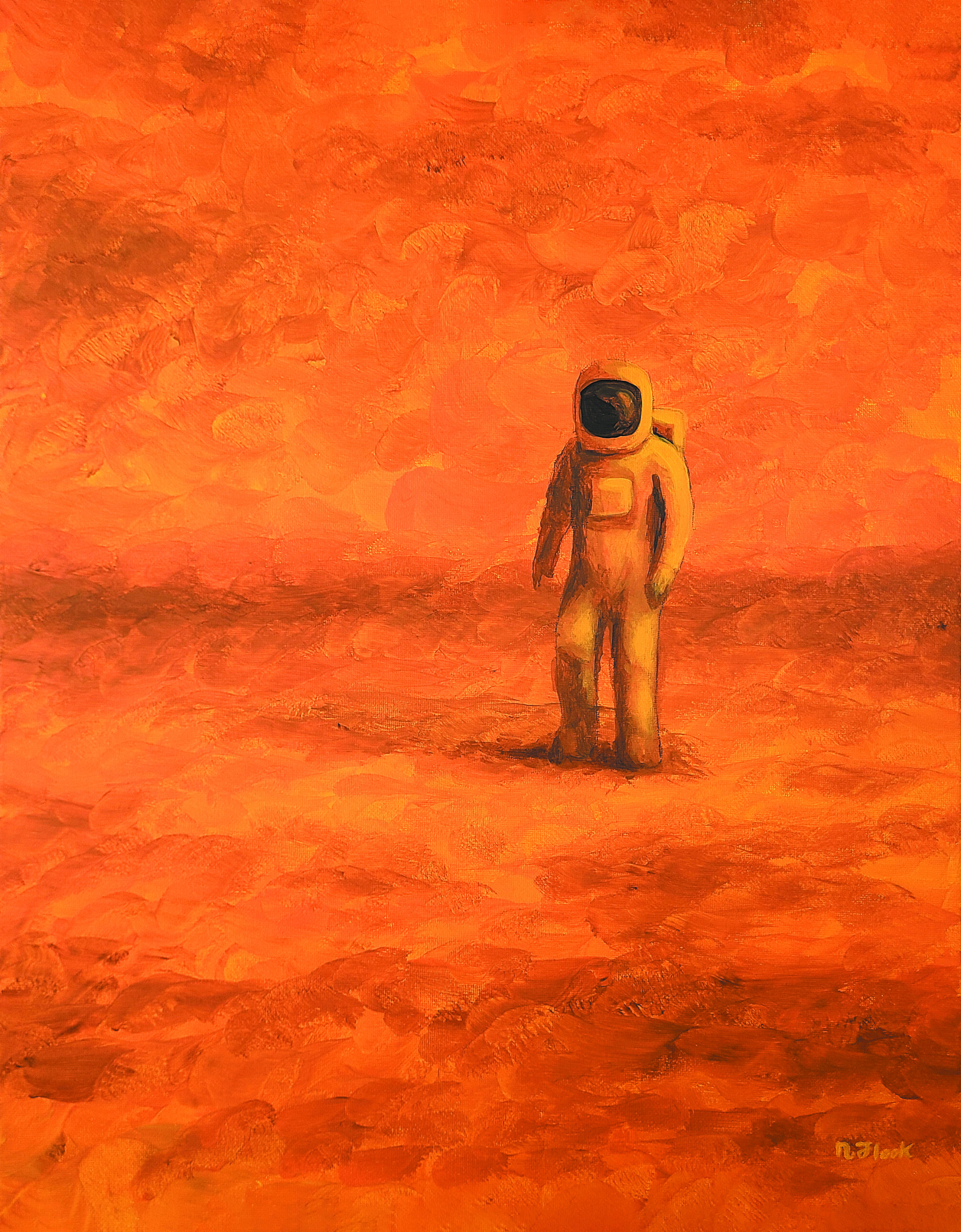
Nick Flook aka Flooko is “the O.G astronaut painter” and takes his fans on adventures through original acrylic paintings and animations. This Toronto-based artist specializes in surrealism, space-themed work and impressionistic city and landscapes. See more of his work on his site, follow him on Instagram.
This is Devin’s Debut with Birdy. Keep your eyes peeled to see more work from this talented writer. Check out Nick’s last Birdy install, Blowing Off Steam, in case you missed it, or head to our Explore section to see more by this talented artist.